


cloud gaming and online casinos Key Takeaways
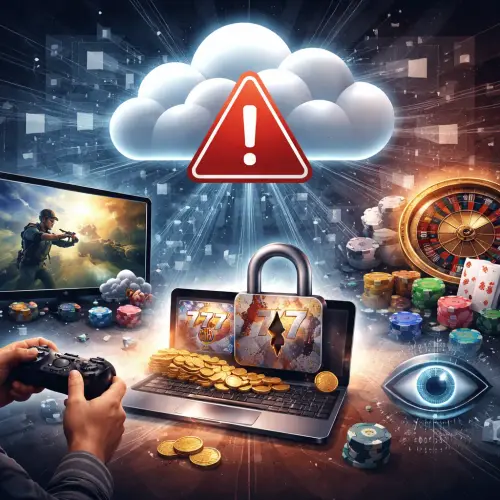
The worlds of cloud gaming and online casinos are converging faster than many realize, bringing new entertainment possibilities — and new risks.
- Cloud gaming and online casinos share core technologies — low-latency streaming and real-time rendering — but differ drastically in trust requirements and regulatory oversight.
- The biggest risks include compromised game fairness due to network latency, increased exposure to account hacking and data breaches, and a patchwork of outdated gambling laws that struggle to keep up with cloud-based platforms.
- Understanding these risks helps players make informed decisions and encourages operators to invest in stronger security, transparent verification, and proactive compliance.
The Technology Behind Cloud Gaming and Online Casinos
At first glance, streaming a triple-A video game and spinning a digital slot machine seem like entirely different experiences. But strip away the graphics and soundtracks, and you’ll find a nearly identical technical foundation. Both rely on powerful remote servers that render content in real time, compress it into video, and stream it to your device with minimal delay.
This shared backbone is what makes convergence possible — and inevitable. Companies like NVIDIA (GeForce NOW), Microsoft (xCloud), and dedicated casino platform providers are all investing in edge computing and 5G networks to reduce lag. However, the stakes are different. A 50-millisecond lag in a shooter game might cost you a kill; a 50-millisecond lag in a real-money blackjack hand could cost you real cash — and raise questions about fairness.
According to a 2024 report from Grand View Research, the global cloud gaming market is projected to exceed $8 billion by 2027, while online gambling is expected to grow at a compound annual rate of 11.5% over the same period. As these sectors expand, their technical and regulatory paths will increasingly cross. For a related guide, see The Future of iGaming in Singapore: 7 Smart Trends for 2026.
Risk #1: Latency and Perceived Fairness in Cloud Gaming and Online Casinos
The first and most insidious risk is latency — not just as a technical nuisance, but as a threat to player trust. In a traditional online casino, the Random Number Generator (RNG) runs on a central server, and every player receives the same outcome deterministically. But when you introduce cloud streaming, the player’s input, the server’s response, and the video feed all travel through the network. Any variance in that path can create a perception — or a reality — of unfairness.
How Latency Affects Game Outcomes
Imagine a live dealer blackjack hand streamed through a cloud platform. If your “hit” command arrives 100 milliseconds later than another player’s, the dealer’s next card — already determined by the RNG — may be dealt before your choice is registered. In regulated jurisdictions, this can violate the requirement that all players receive identical game conditions. A study published in the Journal of Gambling Studies (2023) noted that even minor delays in live-streamed casino games led to increased player complaints about fairness.
What Operators Can Do
To mitigate this risk, operators must implement server-side timestamping and deterministic replay logs. Some progressive platforms are experimenting with “fairness dashboards” that display real-time latency metrics to players. While no solution eliminates lag entirely, transparency goes a long way in maintaining trust.
Risk #2: Cybersecurity Vulnerabilities in Cloud Gaming and Online Casinos
The second major risk cuts across both industries: cybersecurity. Cloud gaming services are juicy targets for attackers because they aggregate high-value user accounts, payment methods, and personal data. Online casinos add the extra layer of financial transactions, making them even more attractive.
Common Attack Vectors
Attackers often exploit weak authentication, session hijacking, or supply-chain vulnerabilities in third-party streaming libraries. In 2023, a major cloud gaming platform suffered a credential-stuffing attack that exposed account details of over 200,000 users. While no casino-specific breach occurred, the incident demonstrated how a vulnerability in the cloud layer could ripple into gambling platforms that share the same infrastructure.
Best Practices for Protection
Players should enable multi-factor authentication on every platform they use. Operators, meanwhile, must adopt end-to-end encryption for video streams and implement hardware-backed security modules for RNG operations. The UK Gambling Commission now recommends that cloud-based gambling services undergo regular penetration testing by independent auditors.
Risk #3: Regulatory Gaps and Compliance Challenges
The third risk is perhaps the most difficult to solve: regulation was never designed for hybrid cloud-casino products. Most gambling laws were written when “online casino” meant a downloaded client or a simple website. Cloud streaming blurs jurisdictional lines — where does the game actually take place? On the server in one country, streamed to a player in another, with data passing through a third?
Jurisdictional Conflicts
This creates headaches for licensing bodies. For example, the Malta Gaming Authority requires that all game logic execute within licensed servers. But if a cloud platform uses distributed edge nodes across multiple countries, does each node need its own license? As of early 2025, no major regulator has issued clear guidance on this question.
What’s Next for Compliance
Industry observers expect a push toward unified technical standards, possibly led by the International Association of Gaming Regulators. In the meantime, forward-thinking operators are voluntarily adopting the strictest standards from any jurisdiction they operate in — a “race to the top” that benefits player safety. For a related guide, see 5 Smart Tips for Singapore Entrepreneurs Entering Gaming Affiliate Industry.
How Players Can Protect Themselves Today
While regulators and companies sort out the big issues, you don’t have to wait. Here is a practical checklist anyone can use before signing up for any platform that combines cloud gaming and online casinos services.
| Checkpoint | What to Look For | Why It Matters |
|---|---|---|
| Licensing information | Clear display of a recognized regulator (e.g., UKGC, MGA, Alderney) | Ensures basic oversight and player recourse |
| Latency disclosure | Dashboard or report showing average ping times for streamed games | Helps you assess fairness risks before playing |
| Multi-factor authentication | SMS, authenticator app, or security key option | Blocks most credential theft attempts |
| Independent audit badge | eCOGRA, iTech Labs, or GLI certification | Verifies randomness and platform integrity |
| Withdrawal track record | Reviews on sites like Trustpilot or AskGamblers | Indicates how the platform handles real money payouts |
Predicting the Future of Cloud Gaming and Online Casinos
Looking ahead, two technologies will accelerate the fusion of cloud gaming and online casinos: augmented reality (AR) and virtual reality (VR).
AR/VR Integration
Imagine wearing lightweight AR glasses and seeing a poker table appear on your coffee table, with cards dealt by a holographic dealer. That experience requires the same real-time rendering that cloud gaming provides. Companies like Meta and Apple are already building the hardware, while casino software developers are prototyping AR blackjack and VR slot lounges. The biggest challenge remains latency — VR demands sub-20-millisecond response times to avoid motion sickness, which is even tighter than the thresholds for fair gambling.
Regulatory Evolution
Regulators are starting to move. In 2024, the European Commission launched a consultation on “virtual worlds and gambling,” signaling that new rules are coming. Likely developments include mandatory latency standards for streamed casino games, data localization requirements, and licenses that specifically cover cloud-based platforms.
For operators, the winners will be those who invest early in transparent fairness systems and robust cybersecurity. For players, the golden rule remains unchanged: only play on licensed, audited platforms, and always know your connection quality before you bet real money.
Useful Resources
For a deeper dive into the technical side of cloud gaming security, read the National Cyber Security Centre’s guidelines on cloud service security. To stay current on gambling regulation updates, follow the UK Gambling Commission’s blog and consultations.
Frequently Asked Questions About cloud gaming and online casinos
What is the main difference between cloud gaming and online casinos ?
Cloud gaming streams interactive video games from remote servers, while online casinos stream games of chance or skill for real money. The technical infrastructure is similar, but online casinos must meet stricter fairness and regulatory standards.
Can cloud gaming technology make online casinos more fair?
Potentially, yes. Cloud platforms can log every input and output with precise timestamps, creating an indisputable record of each game round. If operators make these logs available for independent audits, it increases transparency.
Is it legal to play casino games streamed through cloud services?
It depends on your jurisdiction and whether the platform holds a valid license. Cloud-based casinos are legal in regulated markets like the UK, Malta, and New Jersey, but they are prohibited in many U.S. states and countries with outright gambling bans.
How do latency issues affect game fairness in cloud casinos?
Latency can cause a player’s input (such as “hit” or “stand”) to arrive after the game outcome has already been determined. In regulated environments, this may violate fairness requirements. Players should check if the platform uses server-side timestamps to verify input order.
Are cloud gaming accounts safe from hackers?
No service is 100% safe, but platforms that offer multi-factor authentication, end-to-end encryption, and regular security audits are significantly more secure. Avoid platforms that only use password-based logins.
Will AR/VR casinos require new types of licenses?
Almost certainly. Current gambling licenses don’t specifically cover virtual reality or augmented reality environments. Regulators in Europe and North America are already drafting new rules that address immersive, streamed gambling experiences.
What is an RNG and how does cloud gaming affect it?
RNG stands for Random Number Generator, the algorithm that determines game outcomes. Cloud gaming does not change the RNG itself, but it adds network latency between the server’s output and the player’s perception, which can create fairness concerns.
Can I play cloud casino games on my mobile phone?
Yes. Most cloud casino platforms are designed to work on mobile browsers or apps. However, mobile networks often introduce higher latency than wired connections, so ensure you have a strong, stable signal before playing for real money.
How do cloud casinos handle player data privacy?
Reputable cloud casinos encrypt all data in transit and at rest, comply with regulations like GDPR or CCPA, and allow players to request deletion of their data. Always read the privacy policy before signing up.
What happens if the cloud streaming service goes down during a game?
Policies vary. Some platforms automatically refund bets placed during the interruption, while others consider the game “null and void.” Check the terms and conditions regarding service downtime before playing.
Are there any cloud casinos that use blockchain for fairness?
Yes, a small but growing number of platforms combine cloud streaming with provably fair blockchain technology. These systems allow players to verify each game outcome independently using cryptographic hashes.
Do cloud casinos pay out faster than traditional online casinos ?
Not necessarily. Payout speed depends on the payment method and the casino’s internal processes, not on the streaming technology. Cloud casinos can be just as fast — or slow — as any other online casino.
What should I do if I suspect a cloud casino is rigged?
First, stop playing. Then contact the licensing authority that issued the platform’s license. You can also file a complaint with independent mediation services like eCOGRA. Keep screenshots and transaction records as evidence.
Is 5G necessary for a good cloud casino experience?
No, but it helps. A good 4G LTE connection with low latency can deliver a smooth experience. 5G offers lower latency and higher bandwidth, which becomes more important for future VR casinos than current 2D streaming.
Can cloud gaming help casinos offer more game variety?
Yes. Cloud streaming allows casinos to offer high-fidelity games that would otherwise require a powerful local device. This includes live dealer games with better video quality, 3D slots, and even full-motion video poker.
Do all cloud casino games run on the same servers as cloud gaming platforms?
Not usually. Most cloud casinos use dedicated servers or virtual private servers optimized for low-latency gambling, separate from general cloud gaming services. However, some hybrid platforms are beginning to share infrastructure.
How can I check my internet speed for cloud casino gaming?
Use free tools like Speedtest.net or Fast.com. For cloud casinos, you want at least 25 Mbps download speed and a ping under 50 milliseconds. Higher speeds reduce the risk of visual stutter or missed input timing.
Are there any regulatory bodies that specifically oversee cloud casinos?
As of 2025, no dedicated “cloud casino” regulator exists. Existing bodies like the UK Gambling Commission, Malta Gaming Authority, and New Jersey Division of Gaming Enforcement regulate cloud-based casinos under their traditional online gambling frameworks.
Will AI be used to monitor fairness in cloud casino games?
Yes, several operators are already deploying AI systems that analyze game logs in real time to detect anomalies, such as unexpected RNG patterns or latency-induced bias. This is still an emerging practice but shows promise.
What is the biggest risk a new cloud casino player should watch for?
The biggest risk is playing on an unlicensed platform that lacks independent auditing. Without verification, you cannot be sure the game outcomes are truly random or that your funds are safe. Always verify the license first.

Natalie Yap is a seasoned technical iGaming expert in the Philippine online casino industry, with over 9 years of hands-on experience reviewing and analyzing top casino platforms tailored for Filipino players. She specializes in slot casino games within the Philippine market and is also an experienced technical content writer for YMYL (Your Money or Your Life) websites, where accuracy, trust, and compliance are essential.
In 2026, Natalie is expanding her expertise by actively studying and gaining in-depth knowledge of the Singapore, Malaysia, and Bangladesh iGaming markets, focusing on regional regulations, player behavior, and platform localization.
Responsible Gambling Resources
Responsible Gambling | Gamban | GamBlock | Gambling Therapy | GamCare | GamTalk | GameSense