Responsible Gambling Resources in Singapore Key Takeaways
Singapore offers a robust network of support for individuals and families affected by problem gambling, from confidential helplines to self-exclusion programs.
- The National Council on Problem Gambling Singapore operates a 24-hour helpline (1800-6-668-668) for immediate support and referral.
- Self-exclusion programs, such as the National Self-Exclusion Register and casino-specific Visit Limits, allow individuals to legally ban themselves from gambling venues.
- Counselling services, including those from the Singapore Anti-Narcotics Association (SANA) and WE CARE Community Services, provide professional therapy for gamblers and their loved ones.
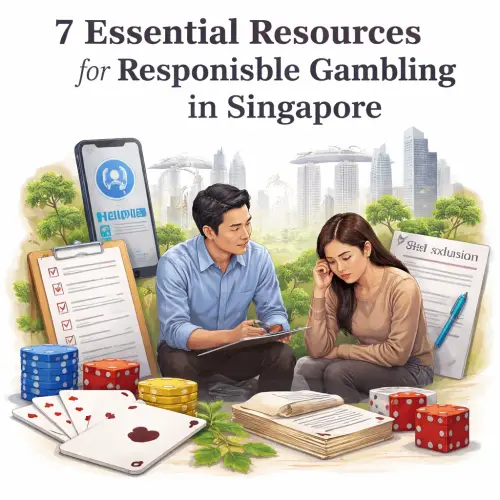
Why Understanding Responsible Gambling Resources in Singapore Matters
Gambling is legal and widely available in Singapore, from the two integrated resorts to local Singapore Pools outlets and online platforms. While many gamble recreationally without issues, a small percentage develop harmful habits. According to the National Council on Problem Gambling (NCPG), about 1 in 50 Singaporean adults (2.1%) screened positive for probable problem gambling during recent surveys. That translates to tens of thousands of individuals directly affected, with ripple effects on families, finances, and mental health. For a related guide, see Singaporean Players: 7 Trusted Help Hotlines for 2024.
The Singapore government, together with community partners, has established a comprehensive ecosystem of Responsible Gambling Resources in Singapore designed to prevent harm, support recovery, and educate the public. Whether you are a gambler seeking help, a concerned friend, or a family member, knowing these resources is the first step toward a healthier relationship with gambling.
Types of Responsible Gambling Resources in Singapore
Helplines and Support Hotlines
The most immediate resource is a confidential helpline. The National Council on Problem Gambling Singapore operates a 24-hour toll-free helpline at 1800-6-668-668. This line provides crisis intervention, emotional support, and referrals to counselling services or self-exclusion programs. It is staffed by trained professionals who speak English, Mandarin, Malay, and Tamil. For a related guide, see Singapore’s Smart and Proven Approach to Online Gambling Awareness.
Another key number is the Singapore Gambling Helpline managed by WE CARE Community Services at 6385-2191 (operating hours vary). This helpline offers similar support and can connect callers to community-based counselling programmes.
Professional Counselling Services for Gambling Help Singapore
Several agencies offer free or subsidised counselling for problem gamblers and their families under the Gambling Help Singapore framework. Key providers include:
- WE CARE Community Services (WCCS) – Specialised gambling counselling, support groups, and financial coaching. Services are available at multiple locations island-wide.
- Singapore Anti-Narcotics Association (SANA) – Provides individual and family counselling specifically for addiction-related issues, including gambling.
- Montfort Care – Offers case management and counselling for individuals and families affected by problem gambling.
Sessions are typically confidential and can be arranged in-person or via telehealth. Many programmes accept self-referrals, so no official diagnosis is needed to start.
Self-Exclusion Programmes: Taking Control of Your Gambling
Self-exclusion is a powerful tool for anyone struggling to limit their gambling. In Singapore, you can legally ban yourself from entering casinos, betting outlets, or accessing online platforms. The main self-exclusion programmes include:
- National Self-Exclusion Register (NSER) – Administered by the NCPG, this register covers all casinos, Singapore Pools outlets, and licensed online gambling sites. A self-exclusion order lasts for a minimum of one year and is renewable.
- Casino Visit Limits – You can set a fixed number of visits per week or month to any casino. This is a less restrictive option for those who want to reduce rather than eliminate visits.
- Voluntary Family Exclusion – Family members can apply to exclude a loved one from gambling venues if they believe the individual is at risk. The application requires professional counselling support.
To enrol in the National Self-Exclusion Program Singapore, you can visit any casino or Singapore Pools branch, or download the application form from the NCPG website. The process is free and confidential.
Educational Resources and Public Awareness Campaigns
Prevention is just as important as intervention. The NCPG leads public education campaigns such as the annual “Responsible Gambling Awareness Week” and the “#BetNotLess” initiative, which encourages gamblers to set limits and stay in control. Online resources include:
- NCPG website (ncpg.org.sg) – Information on self-exclusion, counselling referrals, and downloadable brochures in multiple languages.
- Singapore Pools’ RG Ambassador Programme – Trains gambling staff to identify signs of problem behaviour and offer pamphlets or referrals.
- School-based programmes – Age-appropriate lessons on gambling risks integrated into the national curriculum.
Peer Support Groups and Community Networks
Recovery is often sustained through shared experiences. Several peer-led support groups operate in Singapore:
- Gamblers Anonymous (Singapore) – A 12-step fellowship that meets weekly. Meetings are free and open to anyone with a desire to stop gambling.
- Gam-Anon – A companion group for family members and friends of problem gamblers.
- WE CARE Community Services support groups – Facilitated by professional counsellors, these groups cover topics like money management, relapse prevention, and rebuilding relationships.
Participation in support groups is anonymous and non-judgmental, providing a safe space to share struggles and victories.
How to Choose the Right Resource for Your Situation
Not every resource fits every circumstance. Use the following table to match your needs with the appropriate option:
| Your Situation | Recommended Resource | How to Access |
|---|---|---|
| You need immediate emotional support for a crisis | 24-hour helpline (1800-6-668-668) | Call anytime; no appointment needed |
| You want to reduce gambling visits but not stop entirely | Casino Visit Limit | Apply at casino or NCPG office |
| You want a complete ban from all gambling venues | National Self-Exclusion Register | Complete form at NCPG or casino |
| You need professional therapy for gambling addiction | WE CARE Community Services or SANA | Call to schedule an assessment |
| You want ongoing support from peers who understand | Gamblers Anonymous Singapore | Find a meeting schedule online |
| You are a family member worried about a loved one | Family exclusion application + counselling | Contact NCPG or WE CARE for guidance |
Common Barriers to Seeking Gambling Help Singapore and How to Overcome Them
Despite the availability of Responsible Gambling Resources in Singapore, many people hesitate to reach out. Common concerns include shame, denial, language barriers, and fear of legal consequences. Here is how to address each:
- Shame and stigma – All helplines and counselling services are strictly confidential. No information is shared with employers, family, or law enforcement without your consent.
- Language barriers – The helpline and most counselling providers offer services in English, Mandarin, Malay, and Tamil. Some agencies also have translators for other dialects.
- Fear of being reported – Seeking help does not result in any legal penalty. Problem gambling is treated as a health issue, not a criminal offence.
- Denial about the severity – You do not need to hit “rock bottom” to ask for help. Early intervention can prevent severe debt, relationship breakdown, and mental health crises.
If you are unsure where to start, call the helpline. The operator can listen without judgment and guide you to the right resource.
Useful Resources
For more detailed information, visit the official National Council on Problem Gambling Singapore website (ncpg.org.sg) to download self-exclusion forms, read research reports, and locate counselling centres near you.
If you prefer a community-based approach, the WE CARE Community Services website (wecare.org.sg) offers a comprehensive list of their gambling counselling programmes, support groups, and financial coaching services.
Frequently Asked Questions About Responsible Gambling Resources in Singapore
What is the first step I should take if I think I have a gambling problem in Singapore?
The first step is to call the National Council on Problem Gambling Singapore helpline at 1800-6-668-668. A trained counsellor will listen confidentially and help you decide whether you need counselling, self-exclusion, or other support.
Are the helplines and counselling services free of charge?
Yes, the 24-hour helpline is free to call. Most counselling services offered by agencies such as WE CARE Community Services and SANA are either free or heavily subsidised for Singaporeans and PRs. Some services may charge a nominal fee for specialised therapy, but financial assistance is available.
Can I self-exclude from all gambling venues in Singapore at once?
Yes, the National Self-Exclusion Register (NSER) covers all casinos (Marina Bay Sands and Resorts World Sentosa), Singapore Pools outlets, and licensed online gambling platforms. A single application enables you to exclude yourself from all these venues simultaneously. The exclusion lasts for a minimum of one year and is renewable.
Is self-exclusion permanent?
No, self-exclusion is not permanent. You can choose the duration (minimum one year). After that period, you may apply for removal from the register, but there is a cooling-off period and you must attend a counselling session or interview to ensure you are ready.
Will my employer or family know if I seek help?
All services – helplines, counselling, and self-exclusion – are strictly confidential. Information is only shared with a third party if you give explicit written consent, or if there is an immediate risk of harm to yourself or others. Your employer will never be notified.
Can I exclude a family member who is out of control?
Yes, family members can apply for a Voluntary Family Exclusion or Family Visit Limit. The process requires you to attend a counselling session first, and the excluded person will be notified. It is intended as a compassionate intervention, not a punishment.
What happens if I break my self-exclusion and enter a casino?
If you are caught entering a casino or gambling venue while on the self-exclusion register, you will be asked to leave and may be banned for a longer period. Repeated violations can result in a fine or a police report for trespassing, as self-exclusion is legally binding.
Are online gambling platforms covered by Singapore’s self-exclusion programme?
Yes, the National Self-Exclusion Register covers all licensed online gambling sites operated by Singapore Pools and the two casinos. For unlicensed foreign sites, self-exclusion does not apply. However, your bank or credit card company can block transactions to unlicensed platforms if you request it.
Can I still gamble at social gambling events, like mahjong with friends?
Self-exclusion only applies to licensed gambling venues and authorised online platforms. Private social gambling among friends is not covered, but you are encouraged to set your own limits and avoid gambling that causes distress.
What kind of counselling is available for problem gamblers in Singapore?
Most counselling follows a cognitive-behavioural (CBT) approach, focusing on identifying triggers, managing urges, and rebuilding financial and relationship health. Sessions can be individual, couple, or group-based. Some agencies also offer online counselling.
Is there a support group for family members affected by problem gambling?
Yes, Gam-Anon Singapore runs meetings for family and friends of problem gamblers. WE CARE Community Services also offers family support groups and individual counselling for relatives. These groups address guilt, anger, and practical help such as managing shared finances.
Are there any mobile apps that can help me control my gambling?
Singapore Pools and the NCPG promote the use of the “Gambling Tracker” app, which allows you to set time and money limits, track your spending, and access support resources. The app is free to download on Android and iOS.
Can I get help if my gambling debt is already out of control?
Yes. Counsellors at WE CARE and the NCPG can connect you with Credit Counselling Singapore (CCS) for debt management advice. They can also help you negotiate repayment plans with creditors while you work on behavioural change.
Does the government track how many people use self-exclusion?
Yes, the NCPG publishes annual statistics on self-exclusion registrations, helpline calls, and counselling cases. These reports are available on the NCPG website to monitor the effectiveness of the programmes, but individual identities remain anonymous.
What should I say to a friend who I suspect has a gambling problem?
Express concern without blame, using “I” statements like “I worry about you” rather than “You have a problem.” Offer to help them call the helpline or accompany them to a counselling session. Avoid covering up their debts or lying for them.
Are there any resources specifically for young people or students?
Yes, the NCPG runs a school-based programme called “Learn to Play It Safe” for secondary school and post-secondary students. It covers the risks of gambling and how to resist peer pressure. The helpline is also open to young people.
Can I remain anonymous when applying for self-exclusion?
Your identity is recorded on the register so that casinos and betting outlets can verify you are excluded. However, the register is not publicly accessible, and your name is kept confidential within the system. Only authorised staff at licensed venues can see it.
Is gambling addiction treated as a mental health condition in Singapore?
Yes, the Institute of Mental Health (IMH) recognises gambling disorder as a clinical condition. IMH provides specialised outpatient treatment for severe cases. Your GP can also refer you to a psychiatrist or psychologist specialising in addiction.
How can I help someone who refuses to admit they have a problem?
You cannot force someone to change, but you can set boundaries—for example, not lending them money or covering for their absences. Encourage them to attend at least one counselling session with you. The helpline can offer advice on how to approach this conversation.
Where can I find the latest research and statistics on problem gambling in Singapore?
The NCPG publishes a biennial survey on gambling participation and problem gambling rates, available on their official website. The Singapore Ministry of Social and Family Development also releases occasional research reports on gambling behaviour and related harm.

Natalie Yap is a seasoned technical iGaming expert in the Philippine online casino industry, with over 9 years of hands-on experience reviewing and analyzing top casino platforms tailored for Filipino players. She specializes in slot casino games within the Philippine market and is also an experienced technical content writer for YMYL (Your Money or Your Life) websites, where accuracy, trust, and compliance are essential.
In 2026, Natalie is expanding her expertise by actively studying and gaining in-depth knowledge of the Singapore, Malaysia, and Bangladesh iGaming markets, focusing on regional regulations, player behavior, and platform localization.
Responsible Gambling Resources
Responsible Gambling | Gamban | GamBlock | Gambling Therapy | GamCare | GamTalk | GameSense