

Casino Math vs. Your Math Key Takeaways
The house edge isn’t a secret—it’s the mathematical advantage built into every casino game.
- The house edge is baked into game rules and payouts—it’s not a myth or a conspiracy.
- Three common math traps—progressive betting, chasing losses, and misunderstanding odds—multiply the casino’s advantage.
- Knowing the real numbers won’t beat the house, but it can save you from losing more than you planned.
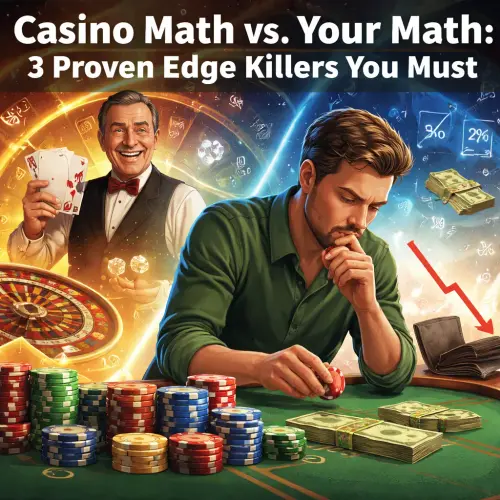
Why Casino Math vs. Your Math Matters More Than Luck
Walk into any casino and you’ll hear stories of big wins, lucky streaks, and near misses. But beneath the flashing lights and celebratory sounds lies a cold, unyielding reality: the math never sleeps. Every spin of the roulette wheel, every roll of the dice, every pull of the slot lever is governed by probabilities that guarantee the casino a profit over time. The reason most players walk away with less than they started isn’t bad luck—it’s ignoring how casino math vs. your math works. You can also browse more posts in guide.
Many gamblers believe they can outsmart the system with betting patterns or gut feelings. But the house edge is not a suggestion—it’s a fixed mathematical factor. Once you understand it, you can stop fighting the numbers and start playing smarter.
The House Edge Explained: Where the Casino’s Advantage Comes From
The house edge is the percentage of each bet that the casino expects to keep over the long run. It’s built into the rules of every game. For example, in European roulette, the single zero gives the house a 2.7% edge. In American roulette, the double zero pushes that to 5.26%. That might not sound like much, but over thousands of spins, it eats away at your bankroll.
Roulette: The Classic House Edge Trap
When you bet on red or black in American roulette, you think your odds are 50/50. But with 18 red, 18 black, and 2 green zeros, your actual chance of winning is 47.37%. That 2.63% gap is the house edge. In the long run, the casino will win that percentage of every dollar wagered. No betting strategy—Martingale, Fibonacci, or otherwise—can change those odds.
Slots: The Invisible House Edge
Slot machines don’t display their odds, but the house edge typically ranges from 2% to 15% or more. The random number generator ensures each spin is independent. There’s no pattern to exploit. The longer you play, the closer your losses will match the machine’s programmed edge. That’s pure casino math in action.
Blackjack: The Game with the Smallest Edge
Blackjack offers the best odds for players—if you use basic strategy. With perfect play, the house edge can drop below 0.5%. But most players deviate: they stand when they should hit, take insurance, or chase losses. Those mistakes widen the edge. Even then, the casino still holds a small mathematical advantage that only disappears with card counting, which casinos actively prevent.
3 Edge Killers: How Player Odds vs Casino Advantage Traps You
Most players fall into three math traps that amplify the house edge. Recognizing them is the first step to protecting your bankroll.
Edge Killer #1: Progressive Betting Systems
Systems like the Martingale—doubling your bet after every loss—seem foolproof on paper. But they require an unlimited bankroll and no table limits. In reality, a short losing streak wipes you out. The math doesn’t change: each bet still carries the same house edge. The system only increases your risk.
Edge Killer #2: Chasing Losses
After a few losses, the urge to “win it back” is powerful. But chasing losses leads to bigger bets, poorer decisions, and faster depletion of your bankroll. The house edge compounds with every additional bet. The best move is often to walk away.
Edge Killer #3: Misunderstanding Probability
Many players believe that after five reds in roulette, black is “due.” That’s the gambler’s fallacy. Each spin is independent. The probability never changes. This misunderstanding of player odds vs casino advantage causes players to bet more aggressively at exactly the wrong time.
A Hypothetical Simulation: Casino Math vs. Your Math in Action
Imagine two players at a roulette table. Player A bets $10 on red every spin. Player B uses a Martingale system, starting at $10 and doubling after each loss. Both play 100 spins of American roulette.
Player A’s expected loss: 100 spins × $10 × 5.26% house edge = $52.60. Player B hits a losing streak of 6 in a row. His bets go: $10, $20, $40, $80, $160, $320. Total loss on that streak: $630. Even if he wins the next spin, he’s only recovered $10 of his losses. The house edge didn’t change—Player B just exposed himself to catastrophic variance.
This simulation shows why understanding casino math vs. your math matters. Player A lost a predictable amount. Player B blew his budget on a single streak.
How to Play Smarter Against the House Edge
You can’t beat the math, but you can manage it. Here’s a quick checklist for any casino visit:
- Know the house edge for every game you play. Blackjack with basic strategy is your best bet.
- Set a loss limit before you start. Stick to it no matter what.
- Avoid progressive betting systems. They increase risk, not reward.
- Never chase losses. The next bet has the same odds as the last one.
- Treat gambling as entertainment, not a way to make money.
This isn’t about pessimism—it’s about realism. The house edge is the price of admission. Understanding it lets you enjoy the experience without the illusion that you can outsmart the system.
| Game | Typical House Edge | Player Skill Impact |
|---|---|---|
| European Roulette | 2.70% | None |
| American Roulette | 5.26% | None |
| Blackjack (basic strategy) | 0.5% – 1% | Significant |
| Slots | 2% – 15% | None |
| Baccarat (banker bet) | 1.06% | Minimal |
Useful Resources
For a deeper dive into game probabilities and expected value, visit the Wizard of Odds—it’s the most trusted independent source for casino game math. If you want to test strategies risk-free, try the Action Network tools for bankroll management and game analysis.
Frequently Asked Questions About Casino Math vs. Your Math
What is the house edge in simple terms?
The house edge is the percentage of each bet the casino expects to keep over the long run. It’s built into the rules of every game.
Can you beat the house edge with betting strategies?
No. Betting strategies like Martingale or Fibonacci change how you bet, but they don’t change the underlying odds. The house edge remains the same.
Why does American roulette have a higher edge than European?
American roulette has a double zero (00) in addition to the single zero, which increases the edge from 2.70% to 5.26%.
What game has the lowest house edge?
Blackjack, when played with perfect basic strategy, has the lowest house edge—often under 0.5%.
Do slot machines have a house edge?
Yes. Slots have a programmed house edge that typically ranges from 2% to 15%, depending on the machine and casino.
Is the house edge the same online as in land-based casinos?
Not always. Online casinos often have lower overhead and may offer better odds on some games, but the house edge still exists. For a related guide, see Best Online Slot Games in Singapore 2026: Expert Picks and Top.
What is the gambler’s fallacy?
It’s the mistaken belief that past events affect future probabilities in independent games like roulette or slots.
Can card counting beat the house edge?
Card counting can shift the edge in the player’s favor in blackjack, but it’s difficult, requires practice, and casinos actively counter it.
Why do casinos offer comps if they already have an edge?
Comps encourage longer play. The longer you play, the more the house edge works in the casino’s favor.
Does the house edge apply to every bet?
Yes. Every bet in every casino game has a built-in house edge, though it varies by bet type (e.g., the tie bet in baccarat has a higher edge than the banker bet).
Is there a way to calculate your expected loss?
Yes. Multiply your average bet size by the number of bets you make and the house edge percentage. That’s your expected loss over time.
Do casino promotions change the house edge?
Promotions like loss rebates or free bets can temporarily reduce the effective house edge, but the underlying game odds don’t change.
Is the house edge a guarantee I’ll lose?
No. The house edge is a long-term statistical average. Short-term variance means you can win or lose in any session.
What is variance in gambling?
Variance is the natural fluctuation in results. High variance means bigger wins and losses; low variance means more consistent, smaller results.
Do professional gamblers beat the house edge?
A small number of professionals use advanced techniques like card counting or poker skill. For most players, the house edge wins over time.
What is the best game for a casual gambler?
Blackjack with basic strategy offers the best odds and involves enough decision-making to be engaging.
Can I use math to win at slots?
No. Slots are pure chance with a fixed house edge. No strategy affects the outcome.
Is the house edge the same for all blackjack tables?
No. It varies by rule variations like deck count, dealer hitting on soft 17, and whether surrender is offered.
Does the casino always win in the long run?
Statistically, yes. The house edge ensures that over millions of bets, the casino will turn a profit.
How do I know the house edge of a specific game?
You can look it up on independent sites like Wizard of Odds or check the game’s rules and payout table at the casino.

Natalie Yap is a seasoned technical iGaming expert in the Philippine online casino industry, with over 9 years of hands-on experience reviewing and analyzing top casino platforms tailored for Filipino players. She specializes in slot casino games within the Philippine market and is also an experienced technical content writer for YMYL (Your Money or Your Life) websites, where accuracy, trust, and compliance are essential.
In 2026, Natalie is expanding her expertise by actively studying and gaining in-depth knowledge of the Singapore, Malaysia, and Bangladesh iGaming markets, focusing on regional regulations, player behavior, and platform localization.
Responsible Gambling Resources
Responsible Gambling | Gamban | GamBlock | Gambling Therapy | GamCare | GamTalk | GameSense