


Avoiding Currency Conversion Fees Key Takeaways
Every time you make a purchase in a foreign currency — whether at a hotel in Paris, a café in Tokyo, or an online store in the UK — there’s a good chance you’re being charged a conversion fee.
- Avoiding currency conversion fees starts with choosing the right payment method before you travel or shop internationally.
- No-foreign-transaction-fee credit cards and fee-free debit cards are your best weapons against unnecessary charges.
- Using local currency, picking fee-free ATMs, and leveraging digital wallets can save you up to 10% on every international transaction.
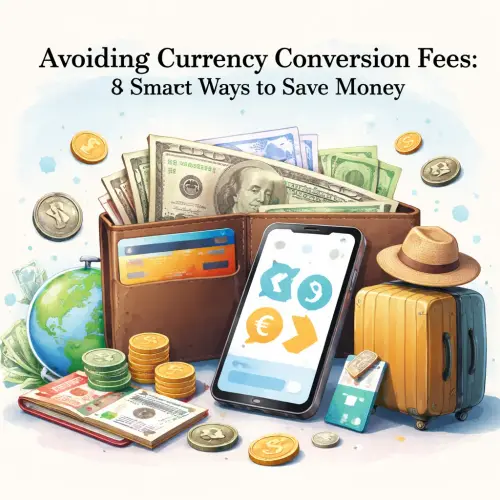
Why Avoiding Currency Conversion Fees Matters More Than You Think
Every time you make a purchase in a foreign currency — whether at a hotel in Paris, a café in Tokyo, or an online store in the UK — there’s a good chance you’re being charged a conversion fee. These fees typically range from 1% to 3% of the transaction amount, but dynamic currency conversion (DCC) can push that number as high as 10%. Over the course of a trip or regular international shopping, that adds up quickly.
The good news? Avoiding currency conversion fees is entirely possible with a little advance planning. You don’t need to accept these charges as a cost of doing business abroad. By understanding how fees work and which tools to use, you can sidestep them almost completely.
How Currency Conversion Fees Actually Work
When you pay with a card in a foreign currency, the payment network (Visa, Mastercard, or Amex) converts the amount at its own exchange rate. That rate is usually very close to the mid-market rate you see on Google. The fee you pay comes in two forms: a foreign transaction fee charged by your bank (typically 1%–3%), and a markup embedded in the exchange rate (often 1%–2%). Merchants can also add a DCC fee if you choose to pay in your home currency. For a related guide, see Best Payment Methods for Singapore Casino Players – Smart Picks.
9 Proven Strategies for Avoiding Currency Conversion Fees
These nine methods cover cards, cash, apps, and habits. Pick the ones that fit your travel style and you’ll keep more of your hard-earned money.
1. Use No Foreign Transaction Fee Credit Cards
The single most effective strategy is to carry a credit card that charges zero foreign transaction fees. Many premium travel rewards cards, such as the Chase Sapphire Preferred, Capital One Venture Rewards, and the American Express Gold Card, waive these fees entirely. When you use these cards abroad, you pay only the wholesale exchange rate set by the network. Make sure to check your card’s terms before you travel — some cards that are fee-free in the US may still charge a small foreign fee. For a related guide, see 5 Smart Reasons Singaporean Players Are Adopting Crypto Now.
2. Open a Fee-Free Debit Card for ATM Withdrawals
You’ll often need local cash for taxis, street vendors, or small shops. A debit card from a bank that reimburses ATM fees — like Charles Schwab, Fidelity, or some online-only banks — lets you withdraw cash at foreign ATMs without paying a cent. Schwab’s High Yield Investor Checking account, for example, refunds unlimited ATM fees worldwide and charges no foreign transaction fee. This is one of the best ways to avoid currency conversion fees when you need physical cash.
3. Always Choose Local Currency at the Point of Sale
When you’re at a foreign merchant and the terminal asks if you’d like to pay in your home currency or the local currency, always pick local currency. This is dynamic currency conversion (DCC) at work — it lets the merchant set a terrible exchange rate that can cost you up to 10%. By choosing local currency, your bank or card network handles the conversion at a fair rate. This single choice can save you hundreds of dollars on a single trip. For a related guide, see Casino Banking Strategies for Singaporeans: Avoid 5 Costly Mistakes.
4. Use a Multi-Currency Digital Wallet
Apps like Wise (formerly TransferWise), Revolut, and PayPal now offer multi-currency accounts that let you hold, send, and spend money in dozens of currencies at real exchange rates. Wise, in particular, uses the mid-market rate and charges only a tiny, transparent fee (usually 0.41% to 1%). You can load money in your home currency, convert it to local currency at the best rate, and spend it with a linked card. This is one of the most popular modern methods for avoiding currency conversion fees on online purchases.
5. Pre-Load a Travel Money Card
Travel money cards are prepaid cards that let you lock in an exchange rate before you go. Providers like Travelex and Revolut offer these in multiple currencies. You load the card with US dollars and convert to euros, pounds, or yen when the rate is favorable. Once loaded, you can spend without any additional fees. Just make sure the card you choose has no monthly maintenance fees and offers ATM withdrawals at no extra cost.
6. Avoid Airport Currency Exchanges and Hotel Desks
Airport kiosks and hotel front desks are the most expensive places to exchange money. They typically charge 5% to 15% in fees and give you a terrible rate. The only time you should use them is if you need a small amount of cash immediately upon arrival. For larger amounts, use an ATM from a local bank with your fee-free debit card.
7. Use Bank Transfers for Large Purchases
If you’re buying a property, paying for a major medical procedure, or making a large purchase abroad, a bank-to-bank wire transfer in the local currency can eliminate conversion fees entirely. Services like Wise, OFX, and Revolut Business offer dedicated international transfer options with rates much better than standard bank wires.
8. Check Your Bank’s Partner Network
Some banks have global partnerships that let you use their ATMs or branches fee-free. For example, Bank of America customers can use Barclays ATMs in the UK without a surcharge. Similar partnerships exist with HSBC, Citi, and other international banks. A quick call to your bank’s customer service can reveal free withdrawal options worldwide.
9. Pay with a Mobile Wallet Abroad
Apple Pay, Google Pay, and Samsung Pay use the same underlying card network as your physical card but add an extra layer of security. More importantly, they often bypass DCC prompts because the transaction is processed in the local currency automatically. When you tap to pay, your phone handles the conversion at the network rate. This is a subtle but effective way to avoid currency conversion fees without thinking about it.
Best Ways to Avoid Currency Conversion Fees: A Quick Comparison
Here’s how the top strategies stack up side by side. Use this table to decide which approach fits your trip.
| Method | Fees You Avoid | Best For | Setup Time |
|---|---|---|---|
| No-foreign-fee credit card | 2–3% per transaction | Hotels, restaurants, online shopping | Minutes (apply online) |
| Fee-free debit card | ATM usage fee + 1–3% | Cash withdrawals | Minutes (apply online) |
| Multi-currency wallet | 1–10% DCC markup | Online purchases, larger payments | 10 minutes (sign up) |
| Travel money card | Exchange rate markup | Budget travelers, gift cards | 15 minutes (buy in store or online) |
| Mobile wallet | DCC prompt fee | Contactless in-store payments | Already set up on phone |
Common Mistakes That Cost You Extra
Even savvy travelers slip up. Watch out for these three traps.
Mistake #1: Letting the Merchant Convert for You
When the terminal asks if you want to pay in your home currency, always say no. The merchant’s exchange rate is almost always worse than what your bank would give you.
Mistake #2: Using a Debit Card That Charges a Foreign Transaction Fee
Many standard debit cards from big banks charge 3% per transaction plus a flat ATM fee. That’s 5% or more per withdrawal. Switch to a fee-free account before your trip.
Mistake #3: Carrying Only One Payment Method
If your only card gets lost, stolen, or declined, you may be forced to use a high-fee option. Carry at least one no-foreign-fee credit card and one fee-free debit card as backup.
Useful Resources
For a deeper look into the latest no-foreign-transaction-fee cards, check out NerdWallet’s list of best no-foreign-transaction-fee credit cards. To compare multi-currency wallets like Wise and Revolut, visit Money Under 30’s detailed comparison.
Frequently Asked Questions About Avoiding Currency Conversion Fees
How can I avoid currency conversion fees on international purchases?
Use a no-foreign-transaction-fee credit card, always choose local currency at checkout, and consider a multi-currency digital wallet like Wise for online payments.
Is it better to use credit or debit to avoid currency conversion fees ?
Credit cards are generally better because they offer stronger fraud protection and often waive foreign transaction fees. For cash withdrawals, a fee-free debit card is ideal.
Do all Visa and Mastercard cards have foreign transaction fees?
No. Many travel rewards cards and some bank cards specifically advertise no foreign transaction fees. Check your card’s terms or call your bank to confirm.
What is dynamic currency conversion (DCC) and why should I avoid it?
DCC is when a merchant converts the transaction amount into your home currency at a poor exchange rate. Always decline it and pay in the local currency instead.
How much can I save by avoiding currency conversion fees?
You can save 1% to 10% per transaction, depending on the method you use. On a $5,000 trip, that’s $50 to $500 in your pocket.
Do prepaid travel cards have hidden fees?
Some do. Look for cards with no monthly fee, no ATM withdrawal fee, and a transparent exchange rate. Travelex and Revolut offer fee-free options.
Can I avoid currency conversion fees when shopping online from a foreign store?
Yes. Use a multi-currency wallet like Wise or a no-foreign-fee credit card. Pay in the store’s local currency rather than letting the store convert for you.
What is the best app to avoid currency conversion fees ?
Wise is widely considered the best for transparent exchange rates and low fees. Revolut is also excellent for frequent travelers with its multi-currency account.
Should I exchange money before my trip or use an ATM abroad?
Using a fee-free debit card at a local ATM abroad is almost always cheaper than exchanging money beforehand at a bank or airport kiosk.
Do Apple Pay and Google Pay charge conversion fees?
No. The fee depends on the card linked to the wallet. If you link a no-foreign-fee card, you pay no conversion fee when using Apple Pay or Google Pay abroad.
Can I avoid fees on ATM withdrawals outside the US?
Yes, by using a debit card from a bank that reimburses ATM fees worldwide, such as Charles Schwab or Fidelity. These cards also charge no foreign transaction fee.
Do credit card rewards points offset the foreign transaction fee?
Sometimes, but it’s not guaranteed. A card with 2x points may still cost you 3% in foreign fees, making it a net loss. Better to use a no-foreign-fee rewards card.
What is the best no foreign transaction fee credit card in 2025?
Top contenders include Chase Sapphire Preferred, Capital One Venture Rewards, and the American Express Gold Card. Compare their annual fees and rewards to find your best fit.
Is it worth opening a multi-currency account just for travel?
If you travel internationally more than once a year, yes. The savings on conversion fees and ATM charges can quickly exceed any setup cost or monthly fee.
Do PayPal currency conversion fees apply?
Yes, PayPal charges a 2.5% to 4% conversion fee on top of the exchange rate. It’s generally better to use Wise or a no-foreign-fee card for international payments.
Can I avoid fees by paying in US dollars abroad?
No. Paying in US dollars usually triggers DCC, which adds a markup of 4–10%. Always choose the local currency for the best rate.
Do hotel and car rental companies charge currency conversion fees?
Yes, they often add a service fee on top of the base rate. Paying with a no-foreign-fee card and choosing local currency at checkout minimizes these extra charges.
What should I do if I’m charged a currency conversion fee by mistake?
Contact your bank or card issuer immediately. Many will refund the fee if it was applied incorrectly, especially if you can show you requested to pay in local currency.
Are currency conversion fees tax deductible?
For personal travel, no. For business travel, you may deduct them as a business expense. Consult a tax professional for your specific situation.
What is the best way to avoid currency conversion fees for a long trip?
Combine a no-foreign-fee credit card for most purchases with a fee-free debit card for ATM withdrawals, plus a multi-currency wallet for online bookings. That covers every scenario.

Natalie Yap is a seasoned technical iGaming expert in the Philippine online casino industry, with over 9 years of hands-on experience reviewing and analyzing top casino platforms tailored for Filipino players. She specializes in slot casino games within the Philippine market and is also an experienced technical content writer for YMYL (Your Money or Your Life) websites, where accuracy, trust, and compliance are essential.
In 2026, Natalie is expanding her expertise by actively studying and gaining in-depth knowledge of the Singapore, Malaysia, and Bangladesh iGaming markets, focusing on regional regulations, player behavior, and platform localization.
Responsible Gambling Resources
Responsible Gambling | Gamban | GamBlock | Gambling Therapy | GamCare | GamTalk | GameSense