

e-wallet layering Key Takeaways
Think of e-wallet layering as a high-tech vault inside your phone — it’s a multi-step security architecture that splits, encrypts, and routes your payment data through several protective shields.
- e-wallet layering combines tokenization, encryption, and transaction routing to create a nearly impenetrable defense for digital payments.
- Understanding each security layer helps you choose the right wallet and avoid common pitfalls like phishing and weak PIN habits.
- Real-world examples and expert recommendations show that layered security is not just for tech giants — every user benefits from it.
What Is e-wallet layering and Why Does It Matter?
Every time you tap your phone to pay for coffee or send money to a friend, your transaction passes through a series of invisible security checks. This is e-wallet layering — the practice of stacking multiple security technologies so that even if one layer fails, the others still protect your funds. It matters because digital payment fraud is on the rise, and a single line of defense is never enough. For a related guide, see Multiple Wallets for Safer Casino Banking: 3 Smart Strategies.
In simple terms, think of a medieval castle: the moat, the drawbridge, the walls, and the guards all work together. Your e-wallet uses similar layers: tokenization replaces your card number with a one-time code, encryption scrambles the data, and transaction routing checks every step for suspicious activity. Together, these layers create a system that is far more secure than any single shield.
The Three Core Layers of E-Wallet Secure Transaction Layering
To grasp the full picture, we need to break down the fundamental layers that make up e-wallet secure transaction layering. Master these, and you’ll understand why your old magnetic stripe card feels like parchment and ink.
Tokenization: Your Card Number Never Travels Alone
Tokenization replaces your real card number (the Primary Account Number, or PAN) with a randomly generated token that is valid only for one specific transaction or merchant. Even if a hacker intercepts that token, they cannot reverse-engineer it to get your actual card details. This layer is the moat around your castle.
For example, when you add your Visa card to Apple Pay, the wallet system generates a unique Device Account Number that is stored securely in your phone’s Secure Element. The merchant never sees your real PAN — they only see the token. This means that even a massive data breach at a retailer won’t expose your original card number.
Encryption: Scrambling Data So Only the Right Reader Can Unlock It
Encryption takes your transaction data and scrambles it using complex algorithms. Only the payment processor that holds the correct decryption key can read it. This layer ensures that even if someone captures the data while it travels from your phone to the payment terminal, they see only gibberish.
Modern wallets use end-to-end encryption, meaning the data stays encrypted from the moment you tap until it reaches the bank’s secure server. The NFC chip in your phone and the payment terminal talk in a language that resembles alien code to anyone eavesdropping.
Transaction Routing: The Smart Traffic Cop of Every Payment
Transaction routing is the layer that checks the path your payment takes. It verifies that the transaction is coming from a trusted device, that the merchant is legitimate, and that the amount matches the request. If anything looks unusual — say, a $1 test charge followed by a $500 surge purchase — the routing layer flags or blocks it.
This layer also handles dynamic routing for speed. For instance, if your primary bank’s server is slow, the wallet might route your payment through a secondary processor to ensure you aren’t left waiting at the checkout counter. It’s the guard who checks IDs and also looks for suspicious behavior.
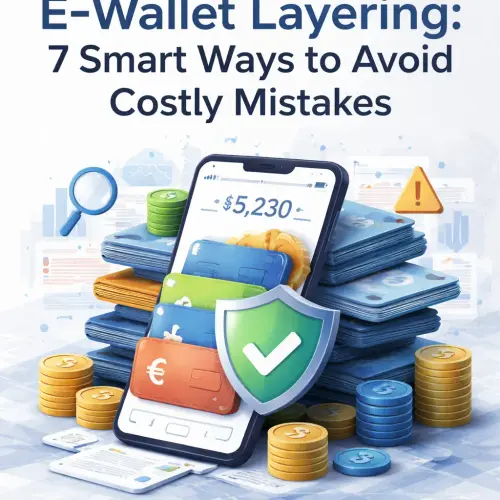
7 Smart Ways to Avoid Costly Mistakes in E-Wallet Layering
Knowing the layers is one thing; using them wisely is another. Here are seven practical tips to make e-wallet layering work in your favor and avoid common traps.
1. Never Share Your Token or Device ID
Your device token is not a secret code you need to memorize — it’s a digital identifier unique to your wallet. Treat it like your house key. If a scammer tricks you into reading it out over the phone, they can link your token to a fake device and drain your funds.
2. Use Biometric Authentication as the First Gate
Fingerprint and face recognition add a layer that only you can bypass. Even if someone steals your phone, they cannot unlock the wallet without your biometrics. This is the drawbridge that stops 99% of casual thieves.
3. Enable Two-Factor Authentication on Your Wallet App
Most major wallets offer two-factor authentication (2FA) for account logins and large transfers. Activate it. This adds a second layer to the digital wallet security layers that protects you even if your password is compromised.
4. Keep Your Operating System and Wallet App Updated
Security patches are released to fix vulnerabilities in the encryption and tokenization layers. Running outdated software is like leaving the castle gate unbolted. Set your phone and wallet app to update automatically.
5. Review Your Transaction History Weekly
Layered security is robust, but no system is perfect. Check your wallet’s transaction log every week for small, unfamiliar charges. Fraudsters often test with tiny amounts before hitting you big. Catching a $1 test charge early can save you thousands.
6. Avoid Public Wi-Fi for Wallet Transactions
Public networks are playgrounds for attackers who can intercept unencrypted data. Even though your wallet uses encryption, a savvy hacker on the same network can try to downgrade the connection or steal session tokens. Use cellular data or a trusted VPN when paying on the go.
7. Choose Wallets with Full Audit Trails
Not all wallets are created equal. Look for apps that provide e-wallet secure transaction layering with a clear audit log, including the token used, encryption standard (AES-256 is best), and routing details. This transparency helps you trace any issue back to its source.
Real-World Examples of e-wallet layering in Action
Let’s look at two scenarios that show the power of layered security — and what happens when it’s missing.
Example 1: The Stolen Phone Scenario
Maria loses her phone on the subway. A thief tries to use her Google Pay to buy electronics. The first layer — biometric authentication — stops them cold because they cannot unlock the phone. Even if the thief somehow bypasses that, the tokenization layer means that the stolen device token is tied to Maria’s biometrics and cannot be used on another phone. The transaction routing layer also detects that the device has suddenly moved to a new location and flags the purchase. Maria’s funds stay safe.
Example 2: The Phishing Call Attack
James receives a call from a scammer pretending to be his bank. The scammer asks for his “wallet security code.” James reads off a code from his app. However, because the code is a single-use token generated by the e-wallet’s tokenization layer, it expires after 60 seconds. The scammer cannot use it. James later checks his transaction history and sees no unauthorized charges. The layered encryption and time-sensitive token prevented the fraud.
Common Risks and How Digital Wallet Security Layers Mitigate Them
No system is invincible, but digital wallet security layers dramatically reduce the attack surface. Here are the main risks and how each layer fights back.
| Risk | How Layering Protects You | Weakness to Watch |
|---|---|---|
| Lost or stolen device | Biometric lock + tokenized cards prevent use | If device PIN is weak, attacker might guess it |
| Data breach at merchant | Tokenization hides real card number | Token could be reused if wallet doesn’t rotate them |
| Man-in-the-middle attacks on public Wi-Fi | End-to-end encryption scrambles all data | Old encryption protocols may be cracked |
| Phishing for wallet credentials | 2FA and session tokens block unauthorized logins | User sharing 2FA codes can bypass it |
Useful Resources
For a deeper dive into how tokenization works under the hood, check out this guide from Stripe’s documentation on tokenization. To understand the latest encryption standards in mobile payments, EMVCo’s official tokenisation specification is the industry standard reference.
Conclusion: Build Your Payment Fortress with E-Wallet Layering
e-wallet layering isn’t just a tech buzzword — it’s the foundation of modern digital payment safety. By understanding how tokenization, encryption, and transaction routing work together, you can choose the right wallet, avoid costly mistakes, and confidently tap, swipe, or click to pay. Remember the seven tips: protect your token, use biometrics, enable 2FA, update your apps, review your history, avoid public Wi-Fi, and choose wallets with full audit trails. The castle is strong, but you are the gatekeeper.
Frequently Asked Questions About e-wallet layering
What exactly is e-wallet layering ?
e-wallet layering is the practice of combining multiple security technologies — tokenization, encryption, and transaction routing — to protect digital payments. Each layer independently guards against different threats.
How does tokenization differ from encryption?
Tokenization replaces sensitive data with a random token that has no mathematical relationship to the original. Encryption scrambles data with a key that can be reversed. Both are key parts of e-wallet secure transaction layering.
Is e-wallet layering 100% secure?
No technology is 100% secure, but layered defenses make it exponentially harder for attackers. Most breaches happen because of user error (like sharing tokens) rather than broken layers.
Do all digital wallets use the same layers?
No. Premium wallets like Apple Pay and Google Pay use all three layers. Budget wallets may skip transaction routing or use weaker encryption. Always check the security specs before choosing a wallet. For a related guide, see Smart Budget Management: 7 Proven Wallet Segmentation Tips.
Can e-wallet layering prevent all fraud?
It prevents most technical fraud, but social engineering (tricking you into giving up information) still works. Layering is strongest against automated attacks, not human deception.
What is the most important layer in e-wallet security?
Tokenization is often considered the most critical because it removes the most valuable data — your real card number — from the transaction entirely. Without it, a breach could expose your PAN.
How does transaction routing help block fraud?
Transaction routing analyzes patterns like location, amount, and merchant history. If a $2,000 purchase suddenly appears from a country you’ve never visited, routing blocks it before authorization.
Do I need a separate app for e-wallet layering ?
No. Modern smartphones and quality wallet apps have built-in layering. You activate it by setting up biometric authentication and enabling security features in the app settings.
Can e-wallet layering slow down payments?
In most cases, the processing is nearly instantaneous. Token generation and encryption take milliseconds. Only very old phones might experience a slight delay.
What’s the difference between one-time and reusable tokens?
One-time tokens expire after a single transaction, offering the highest security. Reusable tokens stay valid for multiple payments but rotate periodically. Most wallets use a mix of both for convenience and safety.
Does e-wallet layering protect against SIM swapping?
Partially. If an attacker swaps your SIM, they could intercept 2FA codes. However, biometrics and device-level tokens remain tied to your physical phone, so they still can’t unlock your wallet without your face or fingerprint.
Is e-wallet layering the same as multi-factor authentication?
No, but they complement each other. Multi-factor authentication (something you know, something you have, something you are) is a user-facing access control. Layering is a technical architecture behind the scenes.
How often should I update my wallet app for security?
Enable automatic updates. Developers patch vulnerabilities in the layering system regularly. Even a five-day delay could expose you to a known exploit.
Can I use e-wallet layering with any bank?
Most major banks support wallets with full layering. Smaller or regional banks may have limited tokenization support. Check with your bank to confirm they participate in the wallet’s token service provider network.
What happens if the tokenization server goes down?
Wallets usually have a fallback mechanism. If the token server is unreachable, the payment may be declined or routed through an encrypted PAN on a secondary server. The transaction will still complete in most cases, but with a slight delay.
Are QR code payments layered the same way?
No. QR code payments often skip tokenization and encryption because they rely on static codes. This makes them more vulnerable to tampering. Most security experts recommend NFC-based wallets for stronger layering.
How do I know which layers my wallet uses?
Check the wallet’s security documentation or help page. Look for terms like “tokenization,” “end-to-end encryption,” and “fraud detection routing.” If the documentation is vague, choose a different wallet.
Can e-wallet layering protect against fake payment terminals?
Yes. Encryption ensures that a fake terminal cannot read your card data. Tokenization also means that even if the terminal records the token, it’s useless for future transactions.
Is it safe to store multiple cards in one wallet?
Yes, because each card is tokenized separately. A breach of one token doesn’t affect the others. Still, limit the number of high-limit cards stored in a single wallet as a best practice.
What should I do if I suspect a layer has been breached?
Immediately freeze your wallet via the app or your bank, change your passwords, and check transaction history. Contact your wallet provider to request a new token and re-register your device securely.

Natalie Yap is a seasoned technical iGaming expert in the Philippine online casino industry, with over 9 years of hands-on experience reviewing and analyzing top casino platforms tailored for Filipino players. She specializes in slot casino games within the Philippine market and is also an experienced technical content writer for YMYL (Your Money or Your Life) websites, where accuracy, trust, and compliance are essential.
In 2026, Natalie is expanding her expertise by actively studying and gaining in-depth knowledge of the Singapore, Malaysia, and Bangladesh iGaming markets, focusing on regional regulations, player behavior, and platform localization.
Responsible Gambling Resources
Responsible Gambling | Gamban | GamBlock | Gambling Therapy | GamCare | GamTalk | GameSense