

Expected Value Key Takeaways
Walk into any trading chat room or poker forum, and you will hear the same question: "What’s your win rate?
- Expected value calculates risk-adjusted profit; win rate only counts how often you are right.
- A trader with a 40% win rate can be wildly profitable while a 90% win-rate trader goes broke — the difference is EV.
- Focusing on expected value vs win rate shifts your mindset from short-term pride to long-term edge.
Why Expected Value Matters More Than Win Rate
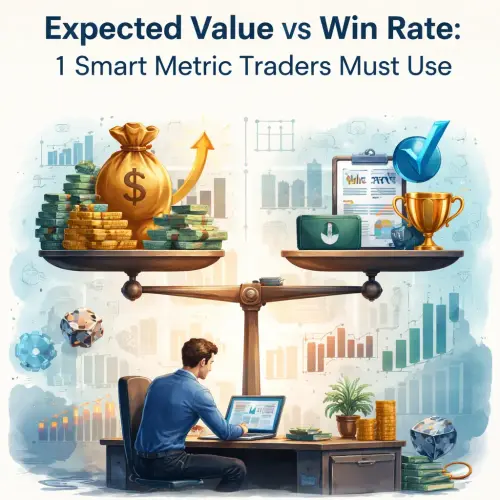
Walk into any trading chat room or poker forum, and you will hear the same question: “What’s your win rate?” It sounds logical — the more often you win, the better you must be, right? Not exactly. In reality, win rate is one of the most dangerous metrics you can chase. It ignores how much you win when you are right and how much you lose when you are wrong. That is where expected value enters the picture.
Expected value (EV) is the mathematical anchor of every smart decision. It answers the only question that matters: “On average, does this trade or bet make me money over time?” It accounts for both frequency and magnitude. That is why professional traders, top hedge funds, and elite sports bettors ignore win rate almost entirely and obsess over EV instead. For a related guide, see Variance vs EV: 5 Critical Trader Mistakes to Avoid.
In this guide, you will understand the core difference between expected value vs win rate, see real-world examples that prove why EV wins every time, and learn how to apply it to your own decisions — whether you trade stocks, place bets, or run a business.
The Flaw of Win Rate: Why Frequency Is a Trap
Win rate measures the percentage of winning trades or bets. If you place 100 trades and win 60, your win rate is 60%. That sounds great, but it tells you nothing about your profit. In fact, a high win rate can mask a terrible strategy.
The Problem with Small Wins and Big Losses
Imagine a trader who wins 90 out of 100 trades. Each win nets $100. Each loss costs $1,000. The win rate is 90%, yet the trader’s total profit is negative: (90 x $100) – (10 x $1,000) = $9,000 – $10,000 = -$1,000. The trader lost money despite winning nine out of ten times.
Win rate alone cannot capture risk or reward. It encourages you to aim for many small wins while ignoring the occasional blow-up that wipes out weeks of gains. That is a psychological trap — feeling good about being “right” while your account shrinks.
Why Professionals Ignore Win Rate
Top-performing traders often have win rates below 50%. Trend-following strategies, for instance, may win only 35-40% of the time. But when they win, the gains far outweigh the losses. Their focus is entirely on expected value — ensuring that every trade has a positive average outcome, regardless of how often it wins. For a related guide, see Expected Value Simplified: 5 Essential Insights for Slot Players.
Understanding Expected Value: The One Metric That Matters
Expected value (EV) is the weighted average of all possible outcomes. In simple terms, it asks: “If I repeat this decision many times, what is my average profit or loss per attempt?”
The Simple EV Formula
EV = (Probability of Win x Average Win) – (Probability of Loss x Average Loss)
If the result is positive, the decision has a positive EV — meaning it makes money over time. If it is negative, you are playing a losing game.
A Concrete EV Example
You place a bet where you have a 50% chance to win $200 and a 50% chance to lose $100.
EV = (0.50 x $200) – (0.50 x $100) = $100 – $50 = $50.
That means each time you place this bet, you average $50 in profit, even though you lose half the time. Over 1,000 bets, you should expect to be up roughly $50,000. That is the power of expected value.
Now contrast that with a “safe” low-risk strategy. You have a 95% chance to win $10 and a 5% chance to lose $500. EV = (0.95 x $10) – (0.05 x $500) = $9.50 – $25.00 = -$15.50. You win 95% of the time, and you are bleeding money.
Expected Value vs Win Rate: The Real-World Showdown
Let us pit the two metrics head-to-head in a scenario any trader or bettor will recognize.
| Metric | Trader A (High Win Rate) | Trader B (High EV) |
|---|---|---|
| Win Rate | 85% | 40% |
| Average Win | $50 | $500 |
| Average Loss | $200 | $100 |
| EV per Trade | (0.85 x $50) – (0.15 x $200) = $42.50 – $30 = $12.50 | (0.40 x $500) – (0.60 x $100) = $200 – $60 = $140 |
| Net Profit After 100 Trades | $12.50 x 100 = $1,250 | $140 x 100 = $14,000 |
Trader B wins less than half as often as Trader A, yet earns over 11 times more money. That is the entire argument for expected value vs win rate in a single table. Trader B’s strategy is built to exploit asymmetric payoffs — small losses, big wins. Trader A is stuck in a grind of tiny wins and occasional large losses that destroy the bottom line.
How to Apply Expected Value in Trading, Betting, and Business
Understanding EV is useless without putting it into practice. Here is how to shift your approach to focus on expected value instead of win rate.
Step 1: Track Everything That Matters
Stop tracking win rate alone. Record: number of trades or bets, profit/loss per trade, size of wins and losses, and probabilities (if estimable). Use a simple spreadsheet or a trading journal app. After 30-50 repetitions, calculate your expected value manually. If it is positive, keep going. If negative, change the strategy.
Step 2: Look for Asymmetric Payoffs
The most profitable opportunities have a “small loss, large gain” profile. In trading, that means tight stop-losses and letting winners run. In business, it means low-cost experiments with high potential upside. In betting, it means identifying odds that are mispriced by the market. The goal is to find decisions where your expected value is high even if your hit rate is low.
Step 3: Ignore Emotional Feedback
Losing three trades in a row feels bad. Your brain will scream at you to change the approach. But if your expected value calculation says the strategy is positive, ignore the noise. Variance is part of the game. A single loss — or even a losing streak — does not invalidate a positive EV strategy. Do not mistake short-term luck for long-term skill.
Common Mistakes When Evaluating Expected Value
Even experienced traders trip up when applying EV. Watch for these pitfalls.
Mistaking Estimated Probability for Certainty
Your EV is only as good as your probability and payoff estimates. If you overestimate your win rate or underestimate loss size, your EV calculation will be dangerously wrong. Be conservative. Use historical data, not optimism.
Ignoring Edge and Sample Size
Positive EV does not guarantee profit in the short term. You need a large sample size — hundreds or thousands of repetitions — for actual results to converge toward expected value. A trader with a 55% win rate can lose money over 20 trades by pure chance. Do not abandon a positive EV strategy after one bad week.
Confusing EV with Expected Return
EV tells you average profit per decision, not total return. A high EV strategy can still be risky if the losses are large relative to your account size. Always pair EV with position sizing and risk management. Positive EV is necessary but not sufficient — you also need to survive the variance.
Final Verdict: Why Expected Value Should Be Your North Star
Win rate feels good. It strokes your ego and makes you look smart in screenshots. But it is a shallow metric that actively harms your long-term results. Expected value is the honest, math-backed measure of whether your decisions actually make money. It forces you to think about size and frequency together — the only combination that matters.
When evaluating any strategy, skip the win rate question. Ask instead: “What is the expected value of this trade, bet, or decision?” If the answer is positive, execute with discipline. If it is negative, walk away — no matter how many times it “feels” like a winner. That is the difference between gamblers and professionals.
Useful Resources
To deepen your understanding of expected value and probability in trading and betting, explore these expert resources:
- Investopedia: Expected Value Definition and Examples — A comprehensive breakdown of EV with financial applications.
- Nature: The role of expected value in decision-making under uncertainty — Academic research on how EV frames optimal decisions in high-stakes environments.
Frequently Asked Questions About Expected Value
What is expected value in trading?
Expected value in trading is the average profit or loss you can expect per trade, calculated by multiplying each possible outcome by its probability and summing them. It tells you whether your strategy is profitable in the long run.
Why is win rate a bad metric?
Win rate is a bad metric because it ignores the magnitude of wins and losses. A high win rate can coexist with negative EV if losses are much larger than wins, leading to long-term losses despite frequent “correct” decisions.
Can you have a positive EV and lose money?
Yes, in the short term. Positive EV means you expect to profit over a large number of trials, but variance can cause losses over small sample sizes. Consistency and patience are essential.
What is expected value vs win rate in betting?
In betting, expected value vs win rate contrasts the average profitability of a bet (EV) against how often it wins. A bet can have a low win rate yet high EV if the odds are skewed in your favor.
How do I calculate expected value for my trades?
Use the formula: EV = (Win Rate x Average Win) – (Loss Rate x Average Loss). Track at least 50-100 trades to get reliable estimates of your win/loss frequencies and amounts.
What is a good expected value in trading?
There is no universal “good” EV — it depends on your risk capital and frequency. A positive EV above $0 is good. Many professionals aim for an EV that is at least 20-30% of their average risk per trade.
Do professional traders care about win rate?
Most professional traders care very little about win rate. They focus on expected value, risk-adjusted returns, and consistency. A low win rate is acceptable if EV is strongly positive.
How does expected value apply to poker?
In poker, every decision has an EV. Calling a bet may have positive EV if the pot odds are favorable, even if you lose the hand. Long-term poker winners maximize EV on every street.
What is negative EV?
Negative EV means that over many repetitions, you expect to lose money on average. Avoiding negative EV decisions is the foundation of any profitable strategy.
Is expected value the same as profit factor?
No. Profit factor is gross profit divided by gross loss. EV is the average net profit per trade. Both are useful, but EV is more intuitive for per-decision evaluation.
How many trades needed to trust EV?
A minimum of 100 trades is recommended to reduce noise. For strategies with high variance, 1000+ trades may be needed before actual results reliably mirror calculated EV.
Can you have a 100% win rate and still lose money?
It is mathematically impossible to have a 100% win rate and lose money — if you never lose, every trade makes money. But in practice, 100% win rates do not exist in markets with any risk.
What is the difference between EV and expectancy?
They are often used interchangeably. Some traders use “expectancy” to mean average profit per trade, while EV is the formal mathematical term. Both refer to the same concept.
Does expected value work for sports betting?
Yes. Sports bettors calculate EV by comparing their estimated probability of an outcome to the implied probability from the odds. A positive EV bet means the odds are in your favor.
How do I improve my expected value?
Improve your edge by refining your probability estimates, cutting losses faster, and letting winners run. Better analysis and consistent risk management increase EV over time.
What is the relationship between EV and risk management?
EV tells you if a decision is profitable, but risk management tells you how much to risk per decision. Even high EV strategies require position sizing to avoid ruin from variance.
Is expected value used in crypto trading?
Absolutely. Crypto traders apply EV to assess volatility, position size, and exit strategies. High volatility can produce positive EV for disciplined traders who manage risk carefully.
What is a common EV mistake beginners make?
Beginners often overestimate their win probability and underestimate loss size, leading to an inflated EV. Smart traders use conservative estimates and backtest rigorously.
Can expected value be negative in a winning streak?
Yes. A short winning streak can occur even when EV is negative. That is why evaluating strategies based on recent results rather than EV is a common and costly mistake.
How do I explain expected value to a beginner?
Tell them: “If I flip a coin and pay you $2 for heads but you pay me $1 for tails, your expected value per flip is $0.50. You will win only half the time, but you will profit long-term.”

Natalie Yap is a seasoned technical iGaming expert in the Philippine online casino industry, with over 9 years of hands-on experience reviewing and analyzing top casino platforms tailored for Filipino players. She specializes in slot casino games within the Philippine market and is also an experienced technical content writer for YMYL (Your Money or Your Life) websites, where accuracy, trust, and compliance are essential.
In 2026, Natalie is expanding her expertise by actively studying and gaining in-depth knowledge of the Singapore, Malaysia, and Bangladesh iGaming markets, focusing on regional regulations, player behavior, and platform localization.
Responsible Gambling Resources
Responsible Gambling | Gamban | GamBlock | Gambling Therapy | GamCare | GamTalk | GameSense