Singapore gambling harm prevention Key Takeaways
Singapore has long maintained a strict stance on gambling, but recent government discussions signal an even stronger push to protect citizens from harm.
- Singapore gambling harm prevention is being strengthened through tighter regulations, public awareness campaigns, and expanded support services.
- Government talks are focusing on early intervention, limiting access, and using data to identify at-risk individuals.
- Social and financial impacts are driving a multi-agency approach that includes education, treatment, and community involvement.
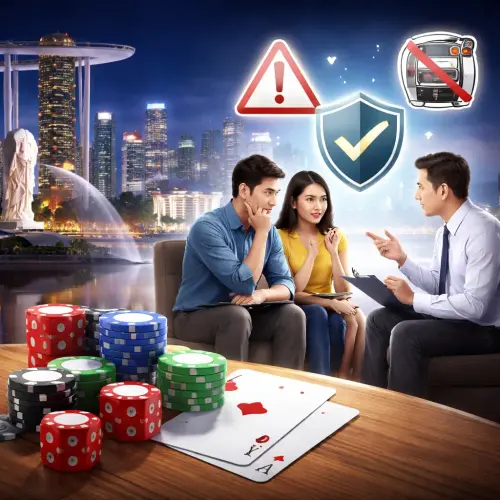
Why Singapore Gambling Harm Prevention Is a National Priority
Gambling is not illegal in Singapore, but it is tightly controlled. The government licenses only two casinos — Marina Bay Sands and Resorts World Sentosa — and operates the Singapore Pools for lottery and sports betting. Despite these controls, problem gambling affects thousands of families each year. That is why Singapore gambling harm prevention has become a top priority for policymakers, healthcare providers, and community leaders.
Recent data from the National Council on Problem Gambling (NCPG) shows that while the overall rate of problem gambling remains low, the severity among affected individuals is increasing. This has prompted the government to review its approach and introduce new safeguards. These efforts are part of a broader national strategy to promote responsible gambling and minimise social harm. For a related guide, see 7 Essential Resources for Responsible Gambling in Singapore.
The Legal Framework Behind the Policy
The Casino Control Act and the Remote Gambling Act are the two main pillars of regulation. They set the rules for who can gamble, where, and under what conditions. The government enforces strict entry levies for locals — S$150 per day or S$3,000 per year — and bans credit for gambling. These measures are designed to limit both access and financial risk. For a related guide, see The Future of iGaming in Singapore: 7 Smart Trends for 2026.
In addition, the Ministry of Home Affairs periodically reviews the list of banned individuals, which includes those who have declared bankruptcy or are receiving financial assistance from the state. This proactive approach helps prevent vulnerable people from entering casinos in the first place.
Expert Warning 1: Early Intervention Is Better Than Cure
One of the key messages emerging from recent government discussions is that waiting until someone develops a serious addiction is too late. The Ministry of Health and the NCPG are now focusing on early warning signs — such as borrowing money to gamble, hiding losses, or skipping work to gamble — and intervening before the problem escalates. Singapore gambling harm prevention programmes now include free counselling hotlines, online self-assessment tools, and brief intervention sessions for those who show early risk.
The National Council on Problem Gambling offers a confidential helpline (1800-6-668-668) and an online chat service for anyone worried about their own gambling or that of a loved one.
Expert Warning 2: Self-Exclusion Is a Powerful Tool
The government has expanded the Voluntary Self-Exclusion (VSE) scheme to cover not just casinos but also Singapore Pools outlets and online gambling platforms. Once enrolled, the individual is legally barred from entering all licensed gambling venues for a minimum of one year, extendable up to lifetime. Breaking this ban carries legal penalties. This simple but effective measure is a cornerstone of Singapore gambling harm prevention and is widely promoted in public awareness campaigns.
How to Enroll in Self-Exclusion
Any citizen or permanent resident can sign up online or at any casino or Singapore Pools outlet. The process is free, confidential, and takes effect within 24 hours. Family members can also apply on behalf of a loved one if they have consent or in extreme cases without it, by petitioning the NCPG.
Expert Warning 3: Financial Protection Must Be Proactive
Gambling harm often starts with small losses that snowball. To counter this, the government now requires all financial institutions to offer voluntary credit restrictions on accounts linked to gambling activities. Banks like DBS, OCBC, and UOB already provide tools to block transactions to casinos and gambling sites. These financial guardrails are a critical part of Singapore gambling harm prevention because they directly limit the amount of money a person can lose.
In addition, the Ministry of Social and Family Development has introduced a Financial Fitness programme that helps families at risk of gambling-related debt to restructure loans and access emergency funds.
Expert Warning 4: Digital Monitoring Is Becoming Smarter
During recent parliamentary debates, officials revealed plans to use data analytics to identify patterns of harmful gambling earlier. For example, if a person suddenly increases the frequency of casino visits or begins using multiple memberships, the system can flag them for a check-in by social workers. This data-driven approach is seen as a major step forward in Singapore gambling harm prevention, though privacy advocates urge caution. The government maintains that all data is anonymised and used strictly for intervention purposes.
Expert Warning 5: Community Support Networks Are Essential
No policy can succeed without community buy-in. That is why the government is investing in grassroots programmes like the Community Health Ambassadors scheme, which trains volunteers to spot signs of gambling harm in their neighbourhoods. These ambassadors refer individuals to professional help and offer peer support. Faith-based organisations, family service centres, and self-help groups like Gamblers Anonymous also play a growing role.
One success story is the “Safer Gambling” campaign run by the NCPG, which uses real testimonials from former gamblers to educate the public. The campaign has reached over a million people through social media, public transport ads, and community events.
How These Measures Impact Singapore Society
The combined effect of these policies is a noticeable reduction in gambling-related harm. According to the latest NCPG survey, the number of people seeking help for gambling problems increased by 15% in the past year — which experts see as a positive sign that awareness is growing. Fewer individuals are reporting severe debt, and more families are seeking help early.
However, challenges remain. The rise of online gambling and cross-border betting poses new risks that require constant vigilance. The government is actively working with international partners to tighten enforcement and close loopholes. Meanwhile, public education continues to emphasise that Singapore gambling harm prevention is a shared responsibility — not just of the state, but of every citizen.
What You Can Do to Stay Safe
If you or someone you know is struggling with gambling, the most important step is to talk to someone you trust and seek professional help. Set clear limits on time and money spent on gambling, and consider using self-exclusion if you feel your control slipping. Remember, the government provides these services for free and with full confidentiality.
For more information, visit Singapore’s Ministry of Home Affairs to see the latest regulatory updates, or explore the resources on the NCPG website.
Useful Resources
- National Council on Problem Gambling (NCPG) – Singapore — Official site with helpline contacts, self-assessment tools, and self-exclusion forms.
- Ministry of Home Affairs – Gambling Policy Page — Latest government announcements on casino regulation, remote gambling laws, and harm prevention initiatives.
Frequently Asked Questions About Singapore gambling harm prevention
What is Singapore gambling harm prevention ?
Singapore gambling harm prevention refers to the set of laws, policies, and public health initiatives designed to reduce the negative effects of gambling on individuals, families, and society. It includes entry levies, self-exclusion schemes, public awareness campaigns, and counselling services.
Is gambling legal in Singapore?
Yes, but only in tightly regulated forms. The government licenses two casinos — Marina Bay Sands and Resorts World Sentosa — and the Singapore Pools for lottery and sports betting. All other forms of gambling are illegal, including most online casinos.
Can I be banned from a casino in Singapore?
Yes. You can voluntarily ban yourself through the Voluntary Self-Exclusion scheme, or the government can impose a ban if you have been declared bankrupt, are receiving public assistance, or have a history of gambling problems.
How much does it cost to enter a casino in Singapore?
Singapore citizens and permanent residents must pay an entry levy of S$150 per day or S$3,000 per year. Tourists enter for free.
What should I do if I think I have a gambling problem?
Call the NCPG helpline at 1800-6-668-668 or use their online chat service. They offer free, confidential counselling and can guide you through self-exclusion and other support options.
What is the NCPG?
The National Council on Problem Gambling (NCPG) is a government-appointed body that oversees gambling harm prevention in Singapore. It runs public education campaigns, funds treatment services, and advises the government on policy. For a related guide, see 5 Safe Gambling Organizations Every Player Should Know.
Can I exclude someone else from casinos?
Yes. Family members can apply to have a loved one excluded if they have valid concerns. With consent, the process is straightforward. Without consent, a petition must be made to the NCPG, who will review the case.
How does self-exclusion work?
Once you sign up for the Voluntary Self-Exclusion (VSE) scheme, you are legally barred from all licensed gambling venues in Singapore for a minimum of one year. Breaking this ban can result in a fine or jail time.
Does the government monitor my gambling activity?
The government uses anonymised data to identify patterns of harmful gambling, but it does not track individual behaviour without cause. Privacy safeguards are in place, and data is used solely for intervention purposes.
Are there free counselling services for gambling addiction?
Yes. The NCPG funds free counselling at several family service centres across Singapore. You can also access online counselling and telephone support. All services are confidential.
What are the signs of problem gambling?
Common signs include spending more time or money on gambling than intended, lying about gambling, borrowing money to gamble, neglecting work or family, and feeling irritable when not gambling.
Can I block my bank account from gambling transactions?
Yes. Major banks in Singapore offer tools to block transactions to casinos and gambling sites. Contact your bank to activate these restrictions — they are free and can be enabled indefinitely.
Is online gambling legal in Singapore?
Remote gambling is generally illegal under the Remote Gambling Act, unless it is operated by Singapore Pools. Many overseas gambling sites are blocked by local internet service providers.
What is the penalty for illegal online gambling?
Individuals caught gambling on illegal sites can be fined up to S$10,000 and/or face up to 6 months in jail. Operators face much heavier penalties.
How can I help a family member who gambles too much?
Start by having an open, non-judgmental conversation. Encourage them to call the NCPG helpline for support. You can also attend a carers’ support group offered by the NCPG or a family service centre.
What is the Singapore Pools?
Singapore Pools is the state-owned operator of legal lotteries, 4D, Toto, and sports betting. It is regulated under the Singapore Totalisator Board Act and is the only legal operator for these games.
Does Singapore have a national gambling helpline?
Yes. The NCPG operates a 24-hour helpline at 1800-6-668-668. It is free, confidential, and available in multiple languages.
Are there in-person support groups for problem gamblers?
Yes. Gamblers Anonymous holds regular meetings in Singapore. The NCPG also runs peer support groups for both gamblers and their family members.
What is the government doing about gambling ads?
The government strictly limits advertising for casinos and Singapore Pools. Ads cannot target minors, make misleading claims, or encourage excessive gambling. Since 2020, all ads must include a harm prevention message.
Are the entry levies effective?
Studies show the entry levy reduces casino visits among locals by about 20%. It is considered one of the most effective financial barriers to prevent casual gambling from becoming habitual.

Natalie Yap is a seasoned technical iGaming expert in the Philippine online casino industry, with over 9 years of hands-on experience reviewing and analyzing top casino platforms tailored for Filipino players. She specializes in slot casino games within the Philippine market and is also an experienced technical content writer for YMYL (Your Money or Your Life) websites, where accuracy, trust, and compliance are essential.
In 2026, Natalie is expanding her expertise by actively studying and gaining in-depth knowledge of the Singapore, Malaysia, and Bangladesh iGaming markets, focusing on regional regulations, player behavior, and platform localization.
Responsible Gambling Resources
Responsible Gambling | Gamban | GamBlock | Gambling Therapy | GamCare | GamTalk | GameSense